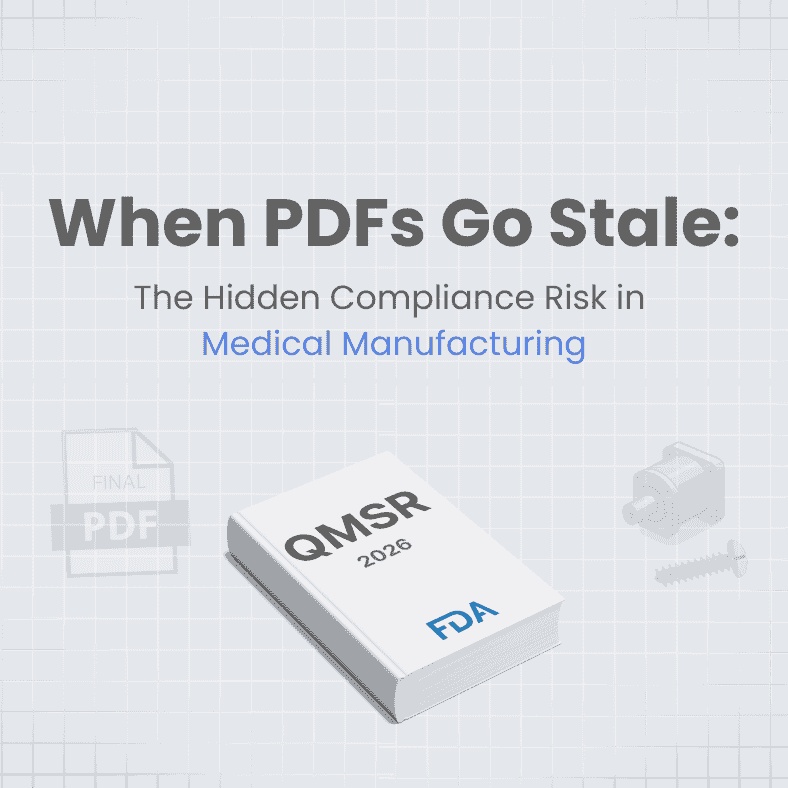
On February 2, 2026, QMSR, the FDA’s updated Quality Management System Regulation that tightens expectations around document control, traceability, and evidence, goes into effect. If your process depends on Word docs and PDFs, you may be exposing yourself to big liabilities.
QMSR is raising the bar. It’s no longer enough to have “a document” on file; teams need clear proof that the right revision was created, approved, distributed, and used at the point of work. When documents and PDFs fall out of sync (as they so often do), you are left with ambiguity and inconsistencies that will show up during an audit.
The Real Problem: Disconnected Documents
For years, PDFs have been the standard for manufacturing documentation because they signal something important: this is final. But in product development, “final” is rarely real. Designs evolve, suppliers change, tolerances get refined, and improvements roll into the next build, often faster than documentation workflows can keep up.
Your team doesn’t have a documentation problem, it has a connectivity problem. You may have tightly integrated CAD, PLM, QMS—and even MES—but what about the documents you create and push into those systems?
Your work instructions live in one place. Your maintenance manuals live somewhere else. Your install guides live in another folder. So when one design change happens—an updated part, a new revision, a swapped component—someone has to manually propagate that change across multiple discrete documents. That manual step is where errors creep in:
- A part number gets updated in one doc, but not the others
- A screenshot stays out of date for weeks (so you just write “update” on it)
- A technician complains that the instructions don’t match the parts in front of him
Do any of these sound familiar? It’s not just an issue of inefficiency. At its core, it’s a compliance problem.
Version Control Gets Messy Fast With Frequent Design Changes
When changes are constantly flowing across a system of disconnected documents, version control becomes chaotic. Even teams with excellent best practices and a top-tier QMS can struggle with version control when the underlying workflow is built on Word docs and PDFs. Design changes happen frequently, and static docs create a constant question: which version is the right one?
A Better Approach: Connect Documentation to the Source of Truth
Quarter20 solves this at the root by connecting your manufacturing documentation directly to CAD, so documentation stays aligned as engineering changes.
Instead of treating docs as static artifacts, Quarter20 treats them as living, connected assets. When information changes in CAD, the docs that depend on that information update too—and not just one document, but all of them. A change in one place becomes a change everywhere.
What this looks like in practice
Say a part is redesigned in CAD and now has a new part number associated with it. In a Word-based workflow, that change requires someone to manually update that change across your entire system of record. It requires relying on “Ctrl-F” (“find” and “replace”) and hoping nothing gets missed.
With Quarter20, those docs are connected to the CAD file from the start—so when the change happens, the linked documents automatically update with:
- the new part number
- the correct visual of the updated design
So your data and the visuals it ties to are always correct.
The Outcome: Less Chaos, Less Risk
When documentation stays synchronized to engineering intent, you reduce the two biggest sources of risk in manufacturing documentation:
- Humans manually copy-and-pasting changes across disconnected files
- Teams acting on outdated information because version control is unclear
Quarter20 takes the burden of version control and propagation off your team, so your documentation can finally function the way regulated manufacturing needs it to: reliable, current, and traceable.
Because in medical manufacturing, documentation isn’t just paperwork - it’s part of the product.
Come find us in Anaheim at MD&M West, February 3-5 at Booth #3830 so we can show you a demo of how this works!
.png)